
The TL;DR (For the Analog Tape Enthusiast)
- Pour a fresh mug of coffee because as we talk about how the launch of the classic Bibi Blocksberg: Hexen gibt es doch figurine (ID: 01-0012) proved that dense, chaotic German audio dramas from 1980 could be successfully ported to physical NFC hardware. This retro engineering required a total overhaul of legacy master files, using precise digital equalization to strip out severe analog tape hiss before broadcasting it through a cute little 3-Watt mono speaker. The production choices behind this release show some serious script optimization, including erasing Bibi's brother Boris from existence to clear up vocal frequencies and keep the spotlight right on our favorite solo female protagonist
The Quest Log
- The Architecture of the Multi-Cast Drama: Engineering a hardware-backed audio ecosystem for multiple overlapping voice actors, shifting the platform away from single-narrator audiobooks.
- The Cold Case of Boris Blocksberg: Production streamlining and script engineering that removed character duplication to optimize acoustic distinction and highlight a singular lead.
- The Tape Hiss Mitigation Protocol: A technical deep dive into the digital equalization matrix required to scrub 1980 analog tape artifacts for deployment on a compressed, modern mono speaker.
The Architecture of the Multi-Cast Drama
When screen-free kids' audio boxes first hit the scene, the early content catalog felt a lot like a solo campaign in an RPG: heavy on standard, single-narrator audiobooks. A single voice reading a story has a predictable, uniform dynamic range that is incredibly easy on low-voltage digital processors, kind of like playing an original Pokemon game on a classic Game Boy. But the real high-level raid boss arrived when the platform integrated the giant archive of classic European audio dramas, known locally as Hörspiel. These are entirely different beasts. They feature a full party of distinct voice actors, complex sound effects, overlapping dialogue, and soaring musical scores mixed decades ago for stereo home setups.
Dropping this specific witch figurine into the launch lineup completely changed what the hardware had to handle. The audio drama format means the box has to survive sudden acoustic peaks without triggering ugly digital distortion. When multiple characters start arguing, laughing, or casting magical spells at the same time, a standard unoptimized compression script will crush the audio into an unintelligible mess, like a chaotic chat channel during a 40-man World of Warcraft raid. For a device controlled entirely by toddlers bumping capacitive ear sensors or tilting the box, absolute clarity is a core stat. If a child cannot tell who is speaking through that internal speaker, the magic breaks instantly. This release forced the system to level up from a basic playback device into a highly optimized processing node capable of handling messy acoustic environments in a compact, child-safe frame.
Side Quest: The Cold Case of Boris Blocksberg
The premiere story, titled Witches Do Exist, contains a fascinating piece of narrative script engineering that perfectly mirrors the needs of clean audio production. In the early recordings from the eighties, the story established a four-person household. Our favorite young witch lived with her mother, her father, and a little brother named Boris. Yet, right after those early episodes, Boris was permanently written out of the entire universe.
This vanishing act was not a careless plot hole: it was a calculated decision by creator Elfie Donnelly to clean up the production architecture. From a character design perspective, Boris was totally redundant. He did the exact same job as the dad, Bernhard, acting as a non-magical, grounded counterweight to the spell-casting family. Officially, the publishing studio Kiddinx confirmed they needed Boris to vanish so Bibi could remain the undisputed star. Donnelly also mentioned in interviews that the names Bibi and Boris were just way too similar for comfort.
Plus, the production team ran into actual acoustic issues. On the primitive analog microphones of the early eighties, tracking multiple young voice actors with overlapping vocal ranges caused massive confusion during rapid-fire dialogue. The mixing boards of the era struggled to keep a clean separation between the kids' voices without introducing phase issues or muddying up the mid-range. To optimize the brand for long-term expansion and ensure absolute clarity on the radio, Donnelly chose to prune the family tree. The script engineers deployed a swift corrective patch: Boris contracted a persistent, chronic cough and was sent away to live with grandparents near the North Sea for his health. He never came back, and his name was systematically scrubbed from future scripts. This deliberate streamlining cleared the acoustic frequency spectrum, eliminated character duplication, and allowed the franchise to lock its focus entirely on a singular, strong female protagonist.
The Tape Hiss Mitigation Protocol
Trying to port an analog master tape recorded in 1980 straight into a modern, cloud-connected digital ecosystem creates some massive technical friction. Vintage magnetic tapes have an inherent physical noise floor: that classic tape hiss sitting in the upper frequencies between six kilohertz and fifteen kilohertz. When you play that unedited analog file back through a low-wattage digital amplifier and a tiny mono speaker, that hiss turns into a distracting, dominant background monster. Because the hardware casing is optimized to protect developing eardrums, it naturally boosts mid-range vocal frequencies so speech stays readable at low volumes. But blindly boosting that mid-range also amplifies the underlying tape hiss, making the story sound like it is broadcasting from an old shortwave military radio.
To fix this, audio engineers had to run the original Kiosk master files through a specialized digital restoration pipeline. They used sharp, surgical notch filters and dynamic equalization curves to suppress the historical tape hiss without stripping away the warm, nostalgic characteristics of the original voice actors. The high-end frequencies were capped to keep the digital-to-analog converter from clipping, while the vital vocal frequencies were carefully isolated and stabilized.
- Source Asset: 1980 Analog Tape Master
- Acoustic Defect: Severe Tape Hiss detected between 6kHz and 15kHz
- Processing Stage: Surgical Digital Filtering
- Correction Vector: Application of targeted Notch Filters and Dynamic Equalization
- Hardware Output: Low-Voltage Mono DAC Output
- End Result: Clear 3-Watt Child-Safe Playback via the internal speaker
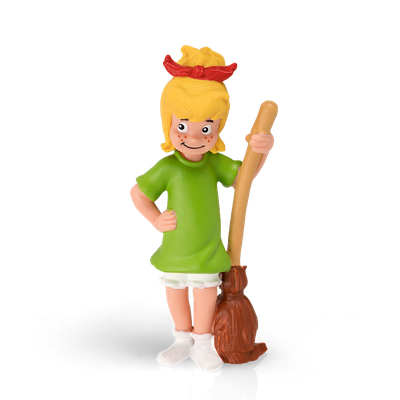
This digital correction works hand-in-hand with the physical engineering of the miniature itself. The figurine is cast in a tough thermoplastic elastomer and painted to look exactly like the original 1980 vinyl and cassette cover art, right down to the vibrant green dress and oversized red hair bow.
From an industrial design standpoint, the sculpture solves a critical balance equation. If the character's broom stuck straight out horizontally from her body, it would act like a mechanical lever arm. Every time a kid handled the toy or bumped the table, that horizontal mass would shift the center of gravity away from the base, breaking the magnetic connection with the box and instantly pausing the track. The engineers completely neutralized this by positioning the broom completely vertical, keeping it tightly flush against her body. This structural layout ensures that the total physical mass stays centered right over the internal neodymium magnet embedded in her feet, maximizing the downward clamping force and keeping the character perfectly anchored during active play.
The Exit Interview
- Golden Nugget: This release proved that legacy multi-cast analog audio could be successfully remastered through strategic frequency filtering and adapted into highly durable, modern physical media without losing its historical character.
- Rapid Fire FAQ:
- Why did Bibi Blocksberg's brother disappear from the audio track? Boris Blocksberg was written out of the script to streamline the cast, remove character duplication that cluttered the narrative, and eliminate acoustic vocal overlap during mixing sessions.
- How do engineers fix the sound of old cassette tapes on modern hardware? They utilize digital restoration suites to apply dynamic equalization and surgical notch filters, slicing away high-frequency tape hiss while boosting vocal mid-ranges for mono speaker playback.
- Next Step: Take a close look at the physical layout of your child's collection. If you are experiencing constant playback interruptions, check if the figurines utilize extended horizontal accessories that create leverage arms, and swap them to the center of the magnetic base to optimize the clamping force.
Disclaimer: Our goal is absolute technical accuracy, but we are human and bugs happen in the code. We never intend to offend, insult, or attack anyone with our content. If you spot a bad data point or a broken fact, please report the post so we can patch it immediately. We are just a three-person squad running this site, managing the daily blog, and prepping the new forums. If you appreciate the grind and want to help us keep the lights on, consider buying us a coffee. It keeps our caffeine levels critical and the servers running.
Reference Log
- https://geizhals.de/tonies-bibi-blocksberg-hexen-gibt-es-doch-01-0012-a1680774.html
- https://mein-mmo.de/en/bibi-blocksberg-had-a-little-brother-who-suddenly-disappeared-after-the-first-episodes,1172429/
- https://support.tonies.com/hc/en-us/articles/29036544804882-How-powerful-is-the-Toniebox-1-speaker